
By Stephen Davis, CFP®, ChFC®, APMA®, Managing Partner, Fairvoy Private Wealth, LLC | November 22, 2026
When technology doesn’t do what we want, we’re generally told to turn it off and on again. With tech and AI stocks acting up in this stock market sell-off, it’s tempting to hit the reset button. Before you do, let’s run through the basics: what’s actually broken, what’s just noise, and what we’re watching next.
Let’s step back a little
The S&P 500 close December 31, 2025, at 6,845.50 and ended at 6,528.52 on March 31, 2026, down 4.6% on a price return basis. At its peak during the first quarter, it had reached 7,002.28 (Jan. 28) falling more than 9% to 6,343.72 (Mar. 30), as the war in Iran pushed energy prices and inflation fears higher. This was just short of what many would call a “correction,” generally described as a 10% pull-back in the broad market. From the March 30 low (6,343) to June 2 high (7,609), the S&P gained nearly 20%, a rally sparked by a ceasefire in Iran, which led to some hope that energy prices and inflation would fall.
The primary gains in the second quarter, were led by AI and semiconductor stocks, with the SOX (semiconductor) index posting a gain of 88%. It was the best quarter on record for the SOX1. These gains accounted for a large part of the overall move within the S&P 500 and only helped to concentrate the market more to technology, something we mentioned during our September Chart of the Month2.
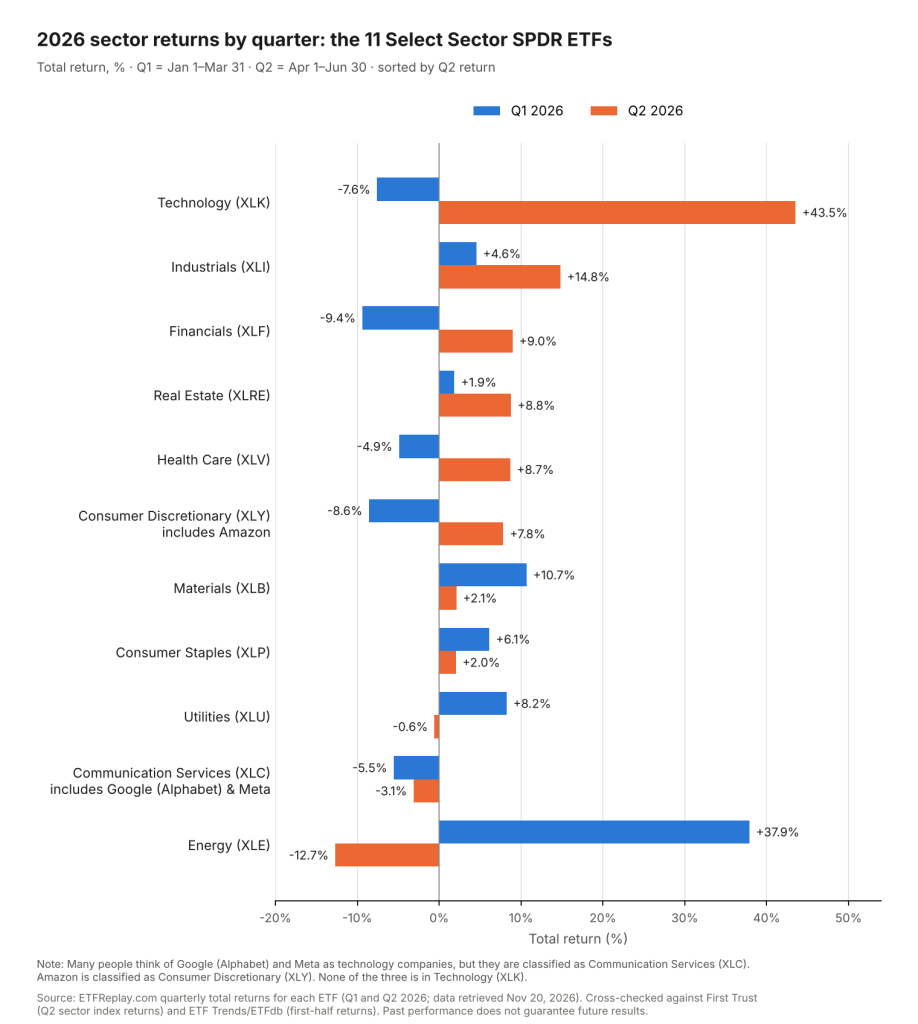
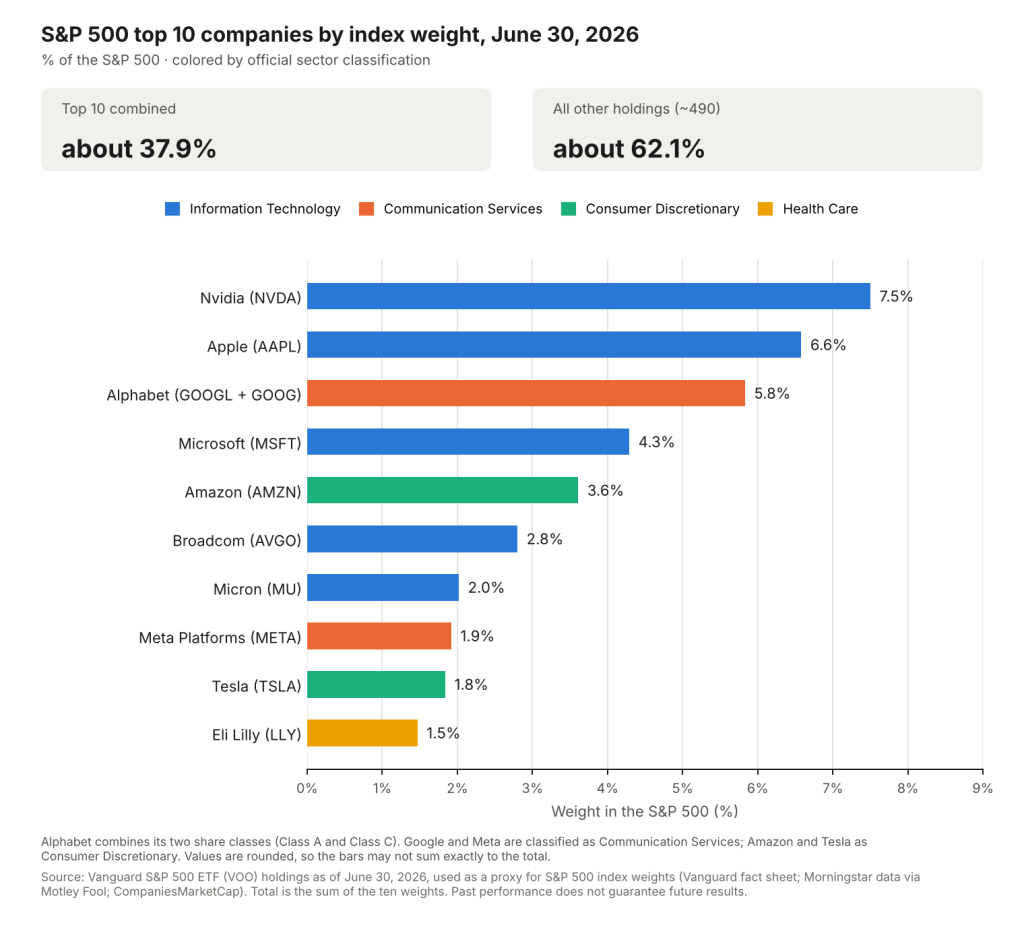
From the above chart, technology stocks had large gains compared to the other sectors as the markets recovered in Q2. However, even that doesn’t show the entire story as each sector is not “equal” when it comes to the S&P 500 market cap design. For example, the energy sector, which was up over 37% during the first quarter, only represents around 3% of the total S&P 500 index, having little overall impact. However, the technology sector, which in 1990 accounted for approximately 7% of the S&P 500, is now over 40%3, especially when you consider stocks like Google, Meta, Tesla, and Amazon, which are classified in sectors outside of technology. Regardless of which sector a stock is technically classified, by the end of the second quarter, the top ten names represented about 38% of the entire S&P 500 per the chart below.
What seems to be bothering the market now
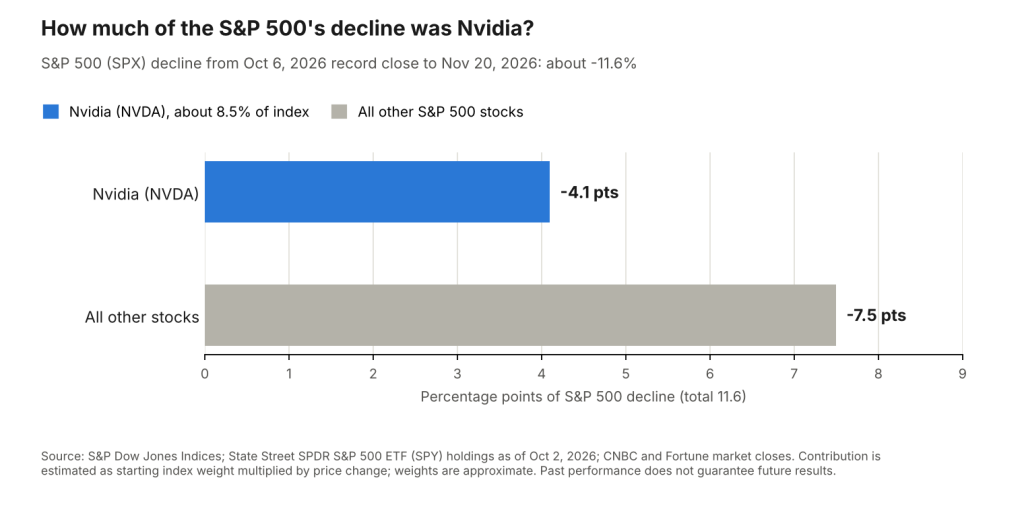
Following the early November elections, many of those elected, particularly at the state level, ran campaigns around slowing or stopping additional data center development. According to the Associated Press, 32 of the 34 winning governor candidates support stronger regulation or restrictions on data centers, and 12 support outright bans or moratoriums4. It remains to be seen whether any of this will become policy, but the artificial intelligence stocks that drove so much of the market’s gains have sold off sharply. Nvidia, one of the best-known names, is now down nearly 50% from its all-time high (as of 11/20/2026 closing), with additional pressure from the sudden resignation of CEO Jensen Huang. Because of their size, the fall in Nvidia and other AI-related technology names has had an outsized impact on the S&P 500, which is down roughly 11.6% from its Oct. 6 record close. Nvidia alone, at roughly 8.4% of the index (as of Nov 30, 2026)5, accounts for approximately one-third of that decline.
Another concern continues to be inflation, which has been running higher than the Federal Reserve “target” of 2%, for many years. Recent speeches given by Federal Reserve officials supporting rate hikes and reports that inflation came in even higher than expected, are leading the market to believe that a 50-basis point increase (half a percent) in rates could soon be announced during the December 9 meeting6. Higher rates are pushing up borrowing costs not only for consumers but also for the U.S. government, which carries a large debt and deficit. Because the Fed is raising rates while inflation continues to run ‘hot’, some are starting to doubt the strategy is working. Chief Economist at First Trust, Brian S. Wesbury, recently wrote7 why he believes the policy of higher interest rates isn’t working.
So where is the “bottom”?
It’s the big question everyone is asking, and it’s a fair one. Weeks like this are uncomfortable, and if you’re feeling uneasy, that’s completely normal. No one can call the exact bottom, but there are a handful of things we’re watching closely over the next few weeks.
The Fed. The Fed meets December 8 and 98. A 50-basis point increase is likely expected, so that move alone shouldn’t surprise anyone. What matters more is how the Fed talks about what comes next, and whether it signals more increases or a pause.
Interest rates. Stocks have been uneasy as the 10-year Treasury yield has pushed toward 5%, so we’re keeping an eye there as well.
Technology and AI. We want to see whether AI stocks stop making new lows, and whether the big technology companies keep investing in AI the way they’ve promised, since that spending supports the whole group.
How the market itself is behaving. No signal can predict a turn with certainty, but some can help. On Friday, November 20, the Nasdaq fell more than 5% and the S&P 500 fell 3.7%, on volume far above normal. That kind of heavy, emotional selling is often called “capitulation,” and it has sometimes shown up near market lows in the past. The S&P 500 is now down about 11.6% from its high, which is in “correction” territory. The Nasdaq is down roughly 18%, from its high, close to the 20% definition of a “bear market.” These are levels than many times lead to new buyers coming into the market.
Another indicator, the VIX index, which is often called the ‘fear gauge’, reached levels that coincided with the previous lows at the end of the first quarter9. This can often a sign which has sometimes accompanied short-term lows.
On Monday, November 23, we could see more selling when the markets open, given how sharp Friday’s decline was. One thing we will be watching for is what is known as a “reversal day.” A reversal day is when the market falls early, often to a new low, and then rallies to finish the day higher than where it closed the day before. It can be a sign that sellers are running out of steam. But one good day does not make a bottom. Reversals can fail, and we would want to see follow-through in the days that come after.
It is also a holiday-shortened week, with markets closed on Thanksgiving Day and closing early on Friday. Trading is generally lighter on total volume which can make moves look bigger than they really are in either direction. So, we will give a reversal on thin holiday volume less weight. This is simply an observation about how markets behave, not a prediction of what will happen.
Here is what gives us additional confidence:
- In 2020, the S&P 500 fell about 34% in just over a month. It was back at a record high by August of the same year.
- In early 2025, the S&P 500 fell nearly 20% from its high. It was back at a record by the end of June.
- Even earlier this year, the market’s first-quarter decline reversed into a strong rally by the spring.
Over my 27 years as an advisor, I’ve seen the same pattern many times: markets fall, some investors panic sell out of the market, and then they may miss the rebound. No one rings a bell at the bottom. Missing the early part of a recovery can meaningfully affect long-term results, which is why we focus on a plan rather than timing.
Technology and AI stocks have taken the brunt of this sell-off. Nvidia, which closed Friday at $125.53, is now nearly 50% below its October 6 peak, and all of the major indexes fell sharply with it. That does not mean the decline is over. This is general education, not a recommendation on any single stock or a prediction of where markets go next, and a stock that has fallen a long way is not necessarily a bargain. Historically, markets have recovered from selloffs, but never on a predictable schedule, and some have taken years. That is why the most important thing is an allocation you can stay with through good times and bad. For many long-term investors, that means staying diversified across asset classes (e.g., stocks, bonds, and cash) and keeping their focus on their long-term plan, not the headlines.
Markets will have their ups and downs, but this week is a good reminder of what matters most. If you have questions or are feeling uneasy about your plan, please call us. That is exactly what we’re here for. We wish you and your family a happy Thanksgiving.
- June, Second Quarter 2026 Review and Outlook | Nasdaq ↩︎
- September 2026 Chart of the Month – Fairvoy Private Wealth ↩︎
- What Past Sector Concentrations Tell Us About Today’s Tech-Heavy S&P 500 – OpenMarkets ↩︎
- A reckoning may await data centers following a beating in the midterms | AP News ↩︎
- Fact Sheet:State Street® SPDR® S&P 500® ETF Trust, Sep2026 ↩︎
- The Odds of a Fed Rate Hike Are 100%. That Would Be 100% Bad. – Barron’s ↩︎
- First Trust ↩︎
- Federal Reserve Board – Calendar ↩︎
- CBOE Volatility Index (^VIX) Historical Data – Yahoo Finance ↩︎
This commentary is presented by Stephen Davis, CFP®, ChFC®, AMPM® and Fairvoy Private Wealth for educational purposes only. It shares general observations about market conditions as of November 20, 2026. It is not personalized investment advice or a recommendation to buy or sell any security, and it does not take into account your goals, time horizon, taxes, or risk tolerance. Please speak with your own financial professional before making changes to your portfolio. All investing involves risk, including the possible loss of principal, and past performance is no guarantee of future results.