Written By: Fairvoy Private Wealth, LLC.
Published On: September 1, 2026
contact@fairvoypw.com
Want to receive our monthly newsletter directly to your inbox? You can update your communication preferences to stay informed.
Monthly Market Summary
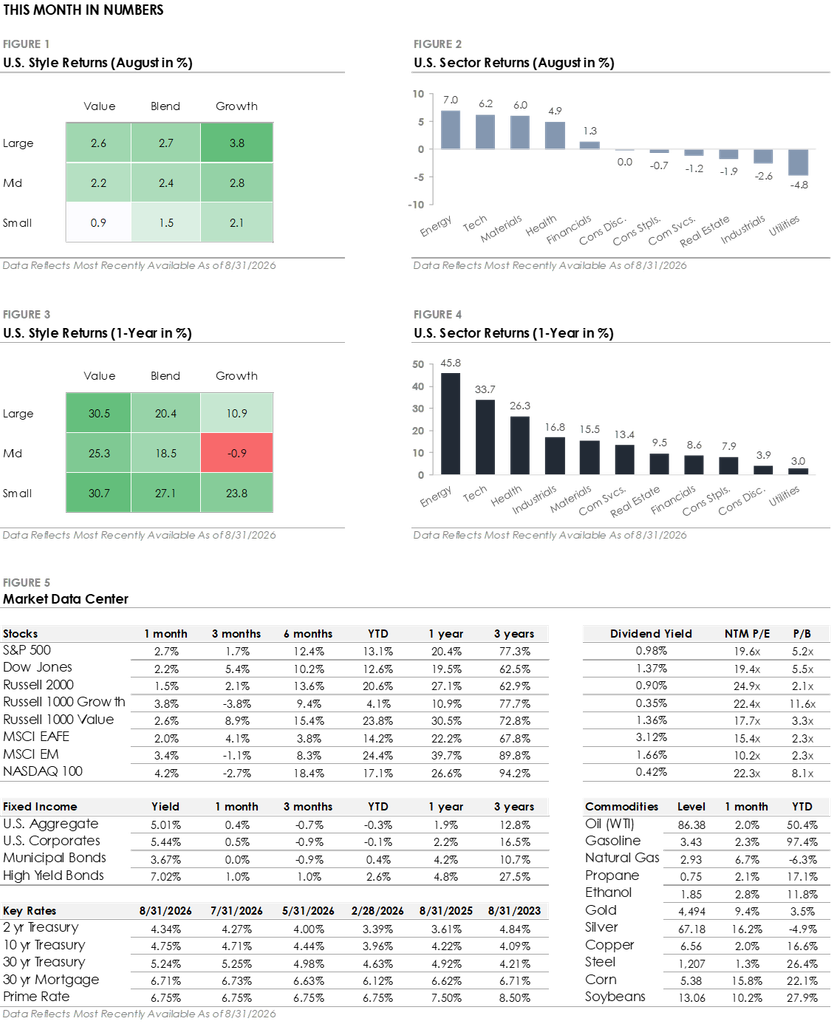
- The S&P 500 Index returned +2.7% in August and set a new high. Five of the eleven S&P 500 sectors traded higher, with four outperforming the broad index. Energy (+7.0%) led all sectors, followed by Technology (+6.2%) as the sector rebounded from a July selloff and Materials (+6.0%) as gold gained nearly +10%. Utilities (-4.8%) led to the downside, followed by Industrials (-2.6%) and Real Estate (-1.9%).
- Bonds traded higher despite Treasury yields rising throughout the month, with the U.S. Bond Aggregate returning +0.4%. Investment-grade corporate bonds modestly outperformed with a +0.5% total return, while high-yield gained +1.0%.
- International stocks traded higher in August. Developed markets gained +2.0% and underperformed the S&P 500, while emerging markets returned +3.4% and outperformed as international tech stocks rebounded alongside U.S. tech stocks.
Stocks Set New Highs Despite Interest Rates Rising Throughout the Month
Equity markets traded higher in August, with strength extending across most broad stock market indexes. The S&P 500, Dow Jones, Russell 2000, and equal-weight S&P 500 all set new all-time highs during the month, and the Nasdaq 100 approached its all-time high from June. The breadth of records was notable because the indexes capture very different parts of the stock market, from mega-cap tech stocks to small-cap stocks and the average S&P 500 company. Market leadership has shifted multiple times this year, alternating between periods of broad participation and concentration. August looked different, with strength spread across a wide range of companies and equity market segments.
The bond market offered a counterpoint to the strength in stocks. Treasury yields experienced broad upward pressure during August, with the 10-year yield climbing above 4.75%, the highest since January 2025, and the 30-year approaching 5.30%, its highest level since 2007. The rise in longer-term yields reflected several concerns, including persistent inflation, elevated government borrowing, and renewed uncertainty around energy prices. Near the end of the month, Fed Chair Kevin Warsh’s Jackson Hole speech signaled that the Fed’s next move could be a rate hike rather than a rate cut, which put further upward pressure on Treasury yields. Despite the rate volatility, corporate credit spreads remained relatively calm and sit near record lows, suggesting investors are more concerned about the path of interest rates than companies’ ability to repay their debt.
Markets Learn to Live with Headline Volatility
Geopolitics have dominated headlines this year, but their impact has changed as the year progresses. Oil prices continue to move when Middle East developments alter the outlook for global energy supply. The difference is that investors appear less willing to treat each new headline as an economic shock. Earlier this year, the start of the conflict and disruption in the Strait of Hormuz caused oil prices to surge and contributed to a broad stock market selloff. Since then, investors have experienced several rounds of escalation and de-escalation. Oil still jumps on new developments, but markets are increasingly waiting for evidence that a headline will affect energy supply, inflation, and economic growth before reacting as dramatically as they did in March. Artificial intelligence is the second dominant market theme. Investors continue to debate whether the large sums being spent on data centers, computer chips, power generation, and networking equipment will ultimately generate adequate returns, but the companies making those investments continue to move ahead. Nvidia’s earnings report provided another indication that demand for AI infrastructure remains strong, with quarterly revenue more than doubling from a year ago. Spending plans across the industry continue to rise as companies race to add computing capacity and build the infrastructure needed to support AI. There are still questions about the eventual return on the hundreds of billions being spent, but the debate in financial markets has done little to slow the companies making the investments.