

Want to receive our monthly Chart of the Month directly to your inbox? You can update your communication preferences to stay informed.
Software Stocks, AI Disruption, and the Importance of Diversification
The software industry has declined nearly -30% from its peak last October, one of the largest non-recessionary drawdowns in over 30 years. Figure 1 puts the decline in historical context alongside the other major software selloffs. The two largest drawdowns before the current one, the dot-com bust and the 2008 financial crisis, both occurred during recessions, when corporate earnings were declining and businesses were cutting spending. The 2022 selloff, driven by the Federal Reserve’s aggressive rate-hiking cycle, was the first major non-recessionary decline and saw software stocks fall nearly -40%. The current drawdown, at nearly -30%, surpasses the COVID pandemic, but it’s driven by a fundamentally different catalyst: artificial intelligence.
The sell-off accelerated in January and February after a series of artificial intelligence (AI) product launches showed that general-purpose AI tools could perform tasks previously handled by specialized software at a lower cost. The market’s reaction was swift and sequential. Software stocks fell first, but concerns quickly spread to other industries, including financial data providers, commercial real estate services, and logistics companies. The sell-off reflected a shift in how investors view AI. For the past two years, AI has been seen as a productivity tool that would help existing companies do more with less. The January and February product launches crossed a threshold: investors started pricing AI as a potential replacement for entire categories of professional services, not just a tool to make companies more efficient.
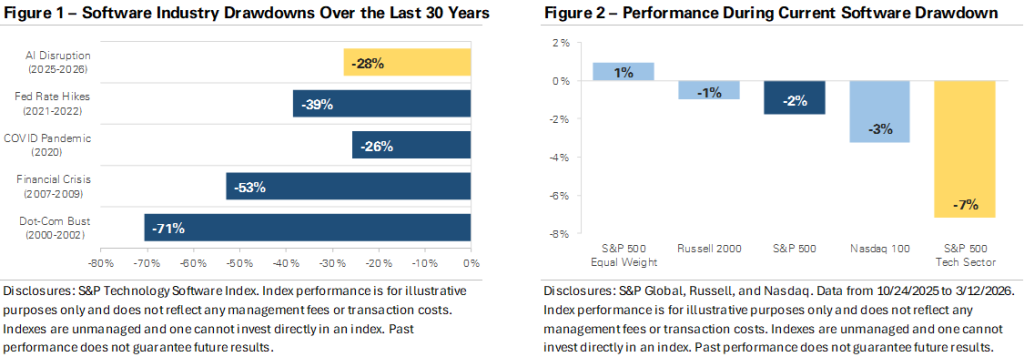
By late February, the narrative around AI disruption began to cool and markets started to stabilize. Wall Street analysts pushed back on the worst-case scenarios, and the conversation shifted from AI would replace entire industries to a more focused debate about which industries are genuinely vulnerable and which will find ways to adapt and develop competitive advantages. Several of the hardest-hit stocks rebounded, and while the software industry partially recovered, it remains down more than -25%. The broader question of how AI will reshape professional services and the enterprise software industry is far from resolved, and its effects may continue to surface across the market as AI tools evolve.
The software industry’s sell-off is a reminder that even well-established businesses can experience rapid repricing when the market’s assumptions about future earnings change. However, Figure 2 shows the direct impact has been limited for diversified investors. International stocks and the average S&P 500 stock have both produced gains, while small-cap stocks, the broader S&P 500, and the Nasdaq 100 are each down low single digits. The takeaway: portfolio diversification across sectors and asset classes remains an effective way to manage the uncertainty that comes with rapidly changing environments and market volatility.
At Fairvoy Private Wealth, we help clients turn financial goals into lasting journeys through personalized planning and disciplined investment management. If you enjoy insights like this, we invite you to stay connected — join our mailing list for monthly market updates, planning resources, and the Chart of the Month. Update your communication preferences or contact us to learn how Fairvoy can help guide your financial journey.